A sprayer mainly changes production speed and how coating reaches the surface. Titan says sprayers get jobs done 3 to 4 times faster than traditional rollers, and up to 10 times on high-production commercial work. The trade-offs are overspray, masking, setup, cleanup and wear parts, and interior walls often still need back-rolling.
Speed: what Titan says about production
Titan's blog states that sprayers get jobs done 3 to 4 times faster than traditional rollers, and up to 10 times faster on high-production commercial jobs. These are Titan's figures, not ours, and they describe large areas where the sprayer can keep moving. They do not apply to a small room that needs hours of masking, or to a job full of trim and cut-in work.
Titan describes airless sprayers as substitutes for rollers, best for large flat areas such as walls, ceilings, exteriors, barns and bridges. Where surfaces are small or complicated, the speed advantage shrinks, and Titan sends that kind of work to HVLP, which it calls a substitute for brushes.
Overspray and masking
Speed comes from pressure, and pressure creates overspray. Titan's example compares about 2,000 PSI on an airless sprayer with about 10 PSI on an HVLP, and notes that the higher fluid pressure produces more overspray. More overspray means more masking, more floor and window protection, and more coating that never reaches the wall.
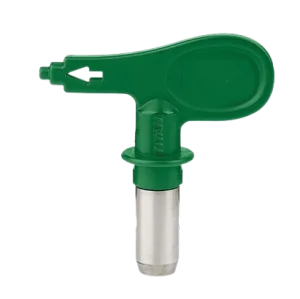
Titan gives two ways to reduce it. Its ControlMax High Efficiency Airless (HEA) tips are described as giving up to 55 percent less overspray, and HEA tips are built to spray architectural coatings at 1000 PSI. HVLP guns are described with a transfer efficiency of 70 to 90 percent, and the Capspray X models quote up to 90 percent. How much coating you lose depends on the sprayer, tip, pressure, distance and hand speed, so there is no single honest percentage for the whole category.
Where each method fits, using Titan's own descriptions
| Method | Best for | Trade-off |
|---|---|---|
| Airless sprayer | Large flat areas: walls, ceilings, exteriors | Higher pressure, more overspray, more masking |
| HVLP | Trim, doors, windows, furniture, cabinets | Slower production; spray distance about 6 inches instead of about 12 |
| Roller or brush | Small areas and cut-in work | Slower on large surfaces |
Finish quality and where it needs help
Titan's blog covers the finish question under back-rolling: after spraying primer on interior walls, a roller pass works the coating into the surface. Two Titan tools combine the steps. The SprayRoller sprays and back-rolls in one motion and takes any standard 9 in. roller cover, and the Inner-Feed Roller wets the roller when you pull the trigger, which suits jobs where spraying is impractical.
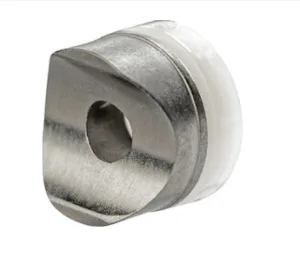
For fine finishes, Titan says a modern electric airless sprayer with a fine-finish tip such as the SC-6+ Synergy can deliver them, but it may slow production a bit and does not suit many medium to high viscosity coatings. The 671-310 SC-6+ 310 fine finish tip is one of the fine finish tips on the site.
Jobs that suit spraying and jobs that do not
- Suits airless: empty rooms, new construction, ceilings, long fences, building exteriors and other big flat surfaces.
- Suits HVLP or a fine-finish tip: cabinets, doors, trim, windows and furniture, where control matters more than speed.
- Suits a roller or brush: a single small wall, a touch-up or a room full of furniture you cannot move.
- Suits a texture sprayer: smooth texture, knockdown and high-build coatings. Titan lists the Impact 1040T for smooth texture and abrasive coatings.
Whatever the surface, read the coating's data sheet for the recommended tip and any thinning. Thin only as the coating maker allows. Whether a given coating will spray on a given sprayer is a question for the data sheet and your manual.
Costs you take on
A sprayer adds work that a roller does not. You set it up, mask the area, strain and stir the coating, and flush the sprayer after every use. Never leave latex or another coating to dry in the pump, hose or gun. The sprayer also has parts that wear: tips open up over time, so flow rises and the fan narrows, and the pump's packings, balls and seats wear with use.
A worn tip is the first thing to check. Titan says a worn tip means excess overspray and waste, so replace it when the pattern degrades. The 661-020 tip seat and seal kit and the tips on the airless spray tips page are the first things to stock. Pump packing kits sit on the repacking kits page, by model.
Accessories that add to the gain
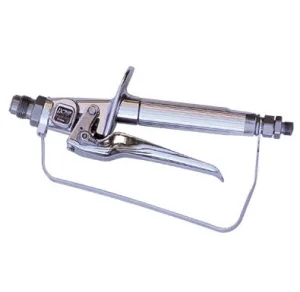
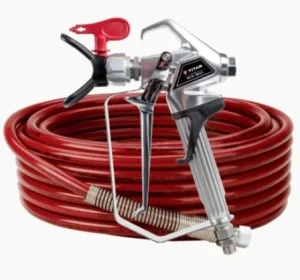
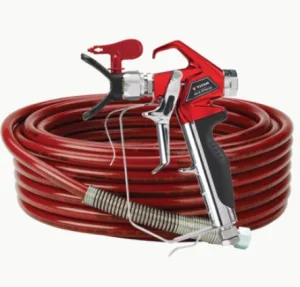
Titan's accessory range makes a sprayer faster to use. Extension poles come in 3 ft and 6 ft sections that link to 12 ft and are rated 3600 PSI. Titan lists a SprayGuide swivel disc with the SprayRoller. The site lists an inline gun, 550-475, and full guns such as the RX-80 (2454979) and RX-Pro (0538022). Browse the accessories page and spray guns and tips page for more, and check that every gun, hose and extension is rated for your sprayer's maximum pressure.
Guns, tips and seals mentioned in this guide:

The Short Version
Spraying changes how fast you cover large flat areas, and Titan puts that at 3 to 4 times faster than rolling. It costs you masking, overspray, setup, cleanup and wear parts, and primer on interior walls often needs back-rolling. Use airless for large surfaces, HVLP or a fine-finish tip for detail, and a roller or brush for small jobs.
Not sure which sprayer or parts you need?
Call (713) 931-0006 with your model and serial number and our parts team will confirm the part before you order.
(713) 931-0006Order by Parts Diagram